
The Margaret Ann Giving Fund Mission
To honor Margaret’s life of self-reliance, kindness, generosity, and creativity by creating a significant and sustainable fund which will continue to inspire and empower others to achieve independence in both life and work and which will provide an opportunity for community to join in celebrating artists and their work.
The Margaret Ann Giving Fund Vison
In partnership with Worcester Center for Crafts, provide opportunities to disabled and underserved through community outreach.
100% of each donation is dedicated to supporting artists, and is fully tax-deductable through the Worcester Center for Crafts, a 501(c)3 organization.
Other ways to give: We gratefully welcome gifts through a Donor Advised Fund, a gift of securities, an employer-matching gift, or other potential sources. For questions, please contact the Center directly: Elaine McKenna-Yeaw, Executive Director, emckenneyyeaw@worcester.edu.
Margaret Ann Duquette. Her Story
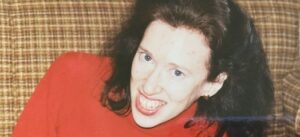
Margaret was a typical child of the early 1950s: full of possibilities.
At that time, pneumonia was more common than now for both adults and children. While still a toddler, Margaret fell ill several times. She grew weary of hospitals. Her dad promised if she could get better this last time, no more hospitals! But in July of 1953, when she was just three and a half years old and a year before the Salk vaccine, Margaret contracted polio, which completely changed the course of her life. It attacked her nervous system targeting motor neurons, initially paralyzing her back, right arm, and right leg. She spent the next few years in and out of hospitals, while residing at The New England Peabody Home for Crippled Children outside Boston, where she received both medical care and all education until age eleven. She underwent numerous surgeries, including a difficult spinal fusion with a post-operative full body cast which was painfully adjusted over the next seven months in an attempt to straighten her back permanently. She kept her spirits up with the hope to return home to her family. Finally, fitted with a back brace for support and a leg brace for mobility, she was released into the world.
For a time, her spinal fusion had proved effective with an almost straight spine but this was elusive. Shortly, after returning home, an orthotist experimented with a textile-sinched brace, which relieved her of the constant pain from the solid back brace, but polio had impaired her back muscles so severely that the spine reverted to profound scoliosis. For the rest of her life, Margaret dealt with a medieval-like torture of being fitted for and living with solid back braces, which caused constant pain but allowed her to move about on her own.
Sixth grade was her first experience in public education. Despite her disability and lack of easy-access buildings at that time, Margaret navigated the local 3-story middle school in Northborough MA and then, Algonquin Regional High School graduating in 1968. At this point, Margaret knew that a driver’s license was critical to her independence and future life. She secured an approval letter from her doctor and petitioned the Massachusetts Registry for authorization to earn her license. Success! But since her right arm and leg were severely limited, she needed automobile modifications which were not commercially available at this time. Her parents gave her a Volkswagen Beetle, with driver’s side equipment modified by her creative father. This became her chariot as she moved onto her next adventure.
Margaret earned her Bachelor of Science degree in psychology from Hobart and William Smith Colleges in Geneva NY, and a Master of Science degree in vocational rehabilitation from Assumption University in Worcester MA. .
The college years had their own set of challenges. Her undergraduate Psychology Department classrooms and labs were located on second and third floors. In addition to textbooks & supplies, Margaret had to carry about twenty extra pounds of braces up those stairs. She defied the odds, initially getting to her classes. Soon, new friends stepped in to support her. And these special people also became her life-long friends.
Later during her graduate internships, she needed to visit clients in 3-story apartment buildings with icy paths and stairs. Since this was before mobile phones, she couldn’t call someone to come out and help. Margaret did not quit; she found her way, albeit cautiously!
After receiving her Master’s, Margaret joined Massachusetts Rehabilitation Commission in 1975, retiring after 40 years in 2015. As a Rehabilitation Counselor, she helped countless clients secure resources and opportunities, assisting individuals with physical, emotional, or intellectual disabilities achieve their aspirations and employment. Even when she had to reduce her hours for health reasons, her dedication to her clients never wavered. She focused on getting to know each client and creating the best possible opportunities for them.
One co-worker’s story captures Margaret’s impact. At a retirement party, an employment services specialist saw Margaret, immediately teared up, and explained that her father had been Margaret’s client when she was young. Because of circumstances beyond his control, he and his family had been struggling. Margaret encouraged and empowered him to continue his education and eventually secure employment. Inspired by Margaret’s attitude, advocacy, and commitment, the woman chose to enter the human services profession.
During the 1980’s, Margaret suffered repeated respiratory failure due to post-polio syndrome. Once again, she was in and out of hospitals, intubated each time due to extremely low levels of O2 and dangerously high CO2. Doctors kept insisting on surgery to insert a breathing tube, but this would have restricted her movements. She declined and dove into researching the latest medical advances for a solution so she could continue to work and thrive in life. She did find a new Bi-Pap machine that would make all the difference. And she found a physician who believed in her and supported her. Life slowed down a little, but she prevailed. Her challenges remained. For many years, she needed 24-hour oxygen, but continue working by using a small portable tank. Still, getting an ordinary cold often meant a stay in ICU, intubated. Normally, doctors sedate intubated patients, but Margaret insisted on remaining conscious, welcoming visitors, and communicating by passing notes! In typical form, she made a life-long friend of her 1980’s Respiratory Therapist and always left the ICU staff gifts of chocolate, nuts, and other treats in thanks for their care.
Margaret always viewed obstacles as challenges, demonstrating her resolve every day, living life to its fullest. Her work was personally fulfilling, and outside of work, she embraced the beauty and wonder in the arts, plays, concerts, crafts shows and outdoor gardens. She expressed her creativity through drawing and photography.
Margaret loved making personal connections wherever she went: co-workers and clients from work, artisans at crafts fairs, merchants at local stores, and wide range of people online. She developed countless life-long friends and, even while being bedridden for the last few years of her life, she continued to maintain them and establish new friendships. Often referred to as Santa, Margaret worked all year to find just the right gift for each person. Greeting card companies loved her, never missing a birthday, anniversary, holiday, or special event. Nestled in a pottery bowl on display at her home, the testament to her life reads: “Sprigs of kindness make a good recipe for life.”
A child of the 1950’s, Margaret shattered preconceived notions of disability, was a force of nature breaking barriers for the next generation, a joyful and generous spirit positively influencing every person she met. Margaret fulfilled her purpose and passion by helping others find their place in the world, both professionally and personally.
She personified possibilities.